Can You Test Indoor Air Quality? Ways To Improve IAQ – Part 4
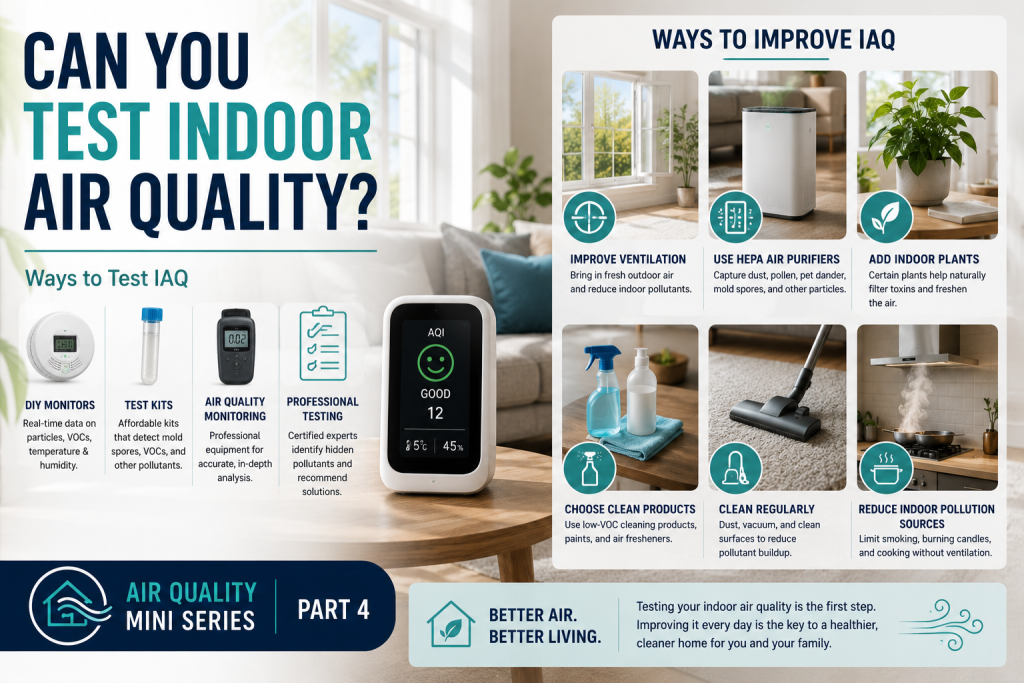
Yes, indoor air quality can be tested, but there isn’t one test that measures everything in your home’s air. Different devices and professional methods are designed to measure different pollutants or conditions.
In Part 4 of our Indoor Air Quality Guide, we’ll explain what indoor air-quality testing can mean and then look at practical strategies for improving the indoor environment, including source control, ventilation, filtration, moisture management, and cleaning.
Navigation
INDOOR AIR QUALITY GUIDE · PART 4 OF 7
← Part 3: Common Indoor Air Pollutants | Start at Part 1 | Part 5: Can Cleaning Improve IAQ? →
Different instruments and professional methods measure different things. Depending on the device or test, measurements might concern particles, carbon dioxide, humidity, VOCs, radon, or a particular contaminant.
That distinction matters because a monitor showing one measurement cannot automatically tell you that every aspect of the air is “good” or “bad.”
If you have a specific concern, such as radon, combustion, significant mold/moisture, or another suspected contaminant, the appropriate test or professional depends on what you’re actually trying to identify.
Read next: How to Test Indoor Air Quality in Your Home
How to Improve Indoor Air Quality
EPA organizes its primary IAQ improvement recommendations around three strategies:
- Source control
- Improved ventilation
- Air cleaning and filtration
Moisture control and appropriate cleaning also play important roles for particular pollutants and indoor conditions.
1. Control pollutants at the source
Whenever possible, address the source rather than trying to compensate for it afterward.
That might mean:
- correcting a moisture problem;
- reducing smoke or combustion sources;
- controlling dust during renovation;
- properly storing household chemicals;
- using exhaust ventilation while cooking;
- reducing accumulated dust; or
- addressing a building or mechanical problem.
EPA describes source control as generally the most effective strategy for many indoor air-quality problems.
2. Improve ventilation when appropriate
Ventilation can dilute pollutants generated indoors and help move them outside.
Depending on the building and outdoor conditions, this might involve windows and doors, kitchen or bathroom exhaust fans, or a mechanical ventilation system.
Consider outdoor conditions first. During wildfire smoke, high pollen, or other outdoor pollution events, unrestricted outdoor ventilation may not be the best approach.
3. Use filtration and air cleaning appropriately
Filtration can supplement source control and ventilation.
Portable air cleaners are generally intended for a room or area, while central HVAC filtration works with air circulating through the home’s heating and cooling system.
Their effectiveness depends on factors including the pollutant, filter efficiency, airflow, equipment size, placement, operation, and maintenance.
And there is an important limitation:
Air cleaners cannot remove every indoor pollutant.
4. Control moisture and humidity
Moisture control can help limit conditions that support mold and certain other biological contaminants.
EPA recommends keeping indoor relative humidity below 60% and ideally around 30–50%.
Leaks and wet materials should be addressed promptly rather than relying solely on dehumidification or surface cleaning.
5. Keep indoor spaces appropriately clean
Dust and other material accumulate on floors, furniture, fabrics, and surfaces.
EPA recommends frequent cleaning to reduce indoor dust buildup and suggests damp dusting because moisture helps prevent settled dust from immediately becoming airborne again. EPA also recommends regular vacuuming and notes that HEPA-filtered vacuums can help reduce some dust escaping back into the air.
This is where ordinary household care intersects directly with IAQ, but it’s only one part of the larger picture.
Maintaining the Cleaning Side of Your Indoor Environment
Improving indoor air quality can involve several strategies, and keeping surfaces from accumulating excessive dust and everyday buildup is one piece of that larger picture. Sweep N Glow provides professional residential cleaning for Connecticut homeowners who want help maintaining their homes on a recurring or more detailed basis.
Explore Residential Cleaning →
Continue the Indoor Air Quality Guide
We’ve mentioned cleaning throughout this guide, but how much can cleaning actually do for indoor air quality, and where are its limits?