CLEANING ZONESEvery Home Has Cleaning Zones
Rooms are defined by architecture. Cleaning zones are defined by activity. A large open-concept kitchen and living area may technically be one room, yet contain several different cleaning zones.
Walls do not have to separate cleaning environments. Sometimes the activities themselves create the boundaries.
MATERIAL MOVEMENTMaterial Moves Between Zones
Cleaning needs do not always remain where they begin. Outdoor grit can enter through a door, move into a hallway, and continue into living areas through foot traffic, pets, airflow, or ordinary household movement.
Something originating in one zone may eventually appear in another.
ACTIVITY VERSUS APPEARANCEThe Most Visible Area Isn't Always the Busiest
A large living room may dominate what someone sees, while a smaller kitchen, narrow hallway, or compact bathroom experiences much more repeated activity.
Visual size and cleaning activity are different measurements.
TRANSITION SPACESTransition Spaces Connect the House
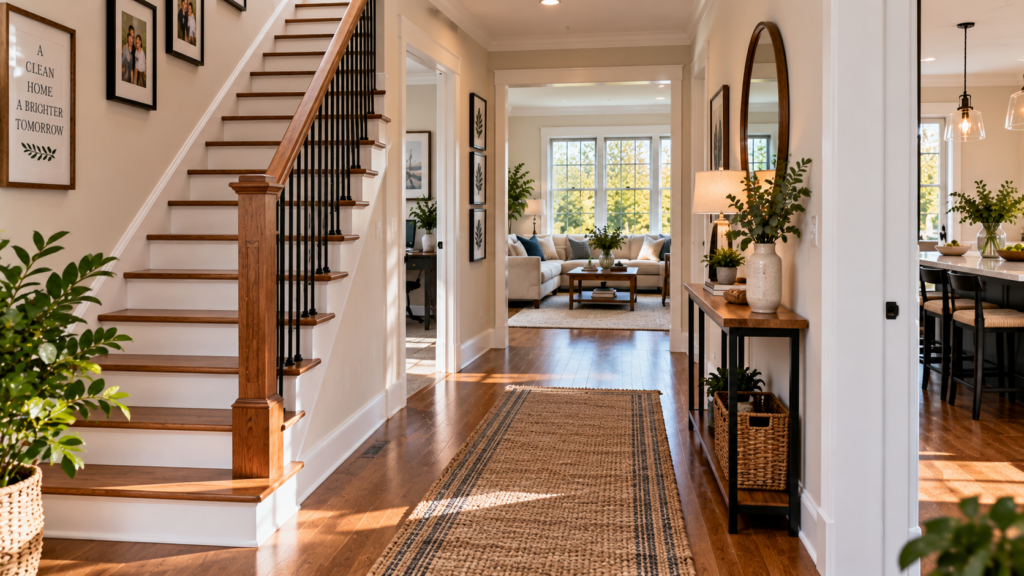
Hallways, stairs, landings, doorways, and passages connect bedrooms, bathrooms, kitchens, entrances, and living spaces.
Transition spaces may not create much material themselves. Their importance comes from what passes through them.
HORIZONTAL SURFACESHorizontal Surfaces Collect What Settles
Shelves, window sills, tables, dressers, desks, countertops, mantels, and appliance tops provide places where airborne particles can settle.
A quiet bedroom shelf and a busy kitchen counter are both horizontal surfaces, but their cleaning cycles can be completely different.
VERTICAL SURFACESVertical Surfaces Develop Different Cleaning Patterns
Walls, cabinet fronts, doors, appliance fronts, shower surrounds, and other vertical surfaces are influenced by hands, water, cooking activity, and other forms of repeated contact.
Cleaning cannot be understood only by looking downward at the floor.
FURNITURE & LAYOUTFurniture Changes the Cleaning Map
A sofa creates surfaces beneath and behind it, floor edges around its legs, and fabric that interacts with dust, fibers, hair, crumbs, and pet activity. Other furniture adds still more surfaces.
Square footage measures the room. It does not measure everything inside it.
CLOSED ROOMSClosed Doors Don't Stop Dust
A room does not need constant foot traffic to change. Fine particles can enter through airflow, while fibers settle from bedding, curtains, rugs, and upholstered furniture.
Low activity changes the type of cleaning need. It does not eliminate it.
HIGH-TOUCH VERSUS HIGH-TRAFFICHigh-Touch and High-Traffic Aren't the Same Thing
A floor can be high-traffic while a light switch is high-touch. Hallways and stairs receive repeated footsteps while handles, faucets, pulls, switches, and shared controls receive repeated hand contact.
Cleaning zones are better understood through behavior than size alone.
ZONES CAN OVERLAPOne Area Can Belong to More Than One Cleaning Zone
A kitchen entrance from the garage can be a transfer zone, a movement zone, and a drop zone for mail, keys, bags, or packages while the nearby kitchen remains a food-preparation zone.
Several cleaning patterns can exist within only a few feet of one another.
CONNECTED CLEANINGCleaning One Area Can Help Protect the Next
Removing tracked-in material near an entrance reduces what is available to travel farther into the home. Maintaining kitchen floors, stairs, and hallways addresses routes connecting multiple spaces.
Connected zones mean work in one area can influence the next.
FLOORING CHANGES THE ZONEThe Same Traffic Can Affect Different Floors Differently
The same household traffic can cross hardwood, tile, carpet, and area rugs, yet fine material, grit, hair, and fibers behave differently on each surface.
Cleaning patterns depend on both what happens in the zone and what the zone is made of.
OPEN-CONCEPT SPACESOpen Floor Plans Can Blur the Boundaries
An open kitchen, dining area, and living room may have no full walls between them. People, pets, crumbs, cooking activity, and foot traffic can move freely across several functional areas.
The architecture says open room. The cleaning pattern may reveal several overlapping zones.
BATHROOM ENVIRONMENTMoisture Changes How a Cleaning Zone Behaves
Bathrooms combine water, personal-care products, repeated hand contact, towels, hair, flooring, fixtures, mirrors, and ventilation within a relatively compact space.
The presence of moisture changes how surfaces are used and the types of residue that may develop.
A CHANGING MAPHousehold Routines Can Redraw the Zones
Working from home, a new pet, changing entrances, guests, rearranged furniture, or renovation work can change how a property functions without changing its architecture.
Cleaning needs should be able to change with the way the property is used.