Frequently Asked Questions About Indoor Air Quality – Part 7
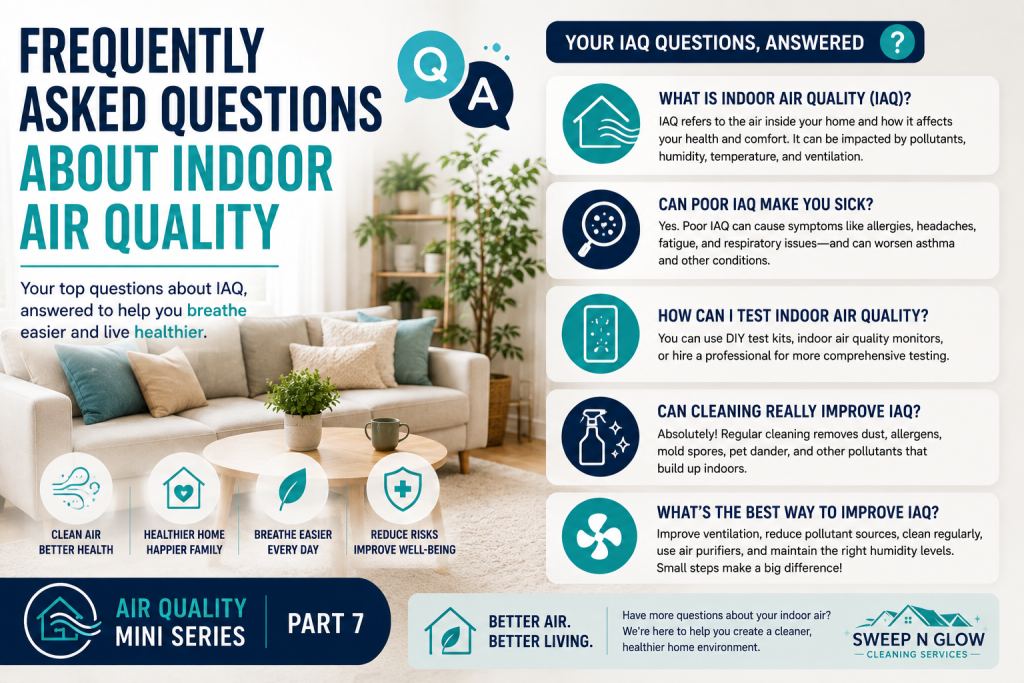
Indoor air quality raises a lot of questions because there isn’t one pollutant, product, or household practice that determines whether indoor air is “good” or “bad.”
This is Part 7 and the final installment of Sweep N Glow’s Indoor Air Quality Guide. Throughout the series, we’ve explored what IAQ means, where indoor pollutants can come from, testing and detection, ventilation and filtration, cleaning, humidity, and challenges found throughout different areas of a home.
Below, we’re bringing together answers to some of the common questions homeowners may have about indoor air quality.
Navigation
INDOOR AIR QUALITY GUIDE · PART 7 OF 7
← Part 6: IAQ Around the Home | Start at Part 1
What does IAQ stand for?
IAQ stands for indoor air quality, referring to characteristics of indoor air that can affect occupants’ health, comfort, performance, and productivity.
What causes poor indoor air quality?
Potential contributors include indoor pollutant sources, inadequate ventilation, moisture and humidity, building materials, household products, combustion, occupants’ activities, building systems, and pollution entering from outdoors.
Can indoor air be more polluted than outdoor air?
Yes. EPA notes that concentrations of some pollutants can be several times higher indoors than outdoors.
Does cleaning improve indoor air quality?
Cleaning can reduce accumulated dust and certain biological contaminants on surfaces and furnishings. It does not correct all IAQ problems.
Does opening windows improve indoor air quality?
Sometimes. Increasing outdoor ventilation can dilute indoor pollutants, but outdoor conditions matter. Smoke, pollen, or other outdoor pollutants may make opening windows undesirable at certain times.
Do air purifiers improve indoor air quality?
Air cleaners and HVAC filtration can reduce some airborne pollutants, but no air cleaner removes every pollutant. They are best considered a supplement to source control and appropriate ventilation.
What humidity level is best indoors?
EPA generally recommends keeping relative humidity below 60%, ideally around 30–50%.
Can remodeling affect indoor air quality?
Yes. Remodeling can generate dust and pollutants from new materials while also disturbing materials already present in a building.
Can a clean home still have poor indoor air quality?
Yes. Some pollutants and building problems cannot be identified or corrected through ordinary cleaning. Radon, carbon monoxide, ventilation problems, combustion issues, and certain VOC sources are examples.
Creating a Better Indoor Environment
Indoor air quality isn’t controlled by a single appliance, cleaning product, or household routine.
A more complete strategy begins by understanding what is entering or being generated inside the building. From there, source control, appropriate ventilation, filtration, moisture management, and property maintenance can work together.
Cleaning has a meaningful, but defined, role within that larger strategy. Removing accumulated dust and maintaining floors, furniture, fabrics, and other surfaces can help reduce some of the material that collects throughout an indoor environment. It cannot replace specialized testing, remediation, mechanical repairs, or environmental controls when those are necessary.
For homeowners who want help keeping up with the cleaning side of that equation, Sweep N Glow provides professional residential cleaning services throughout Connecticut, from recurring home cleaning to more detailed cleaning when a property needs additional attention.
→ Looking for Residential Cleaners in Orange CT
→ Request a Sweep N Glow Quote
Finished Here? Explore More of the Indoor Air Quality Guide
← Return to Part 1: Indoor Air Quality: What It Is, What Affects It, and How to Improve It
Or explore related topics in Health & Wellness → Indoor Air Quality.